podbay

podbay

One console over every Claude Code session on your Mac.

You run a session per repo, per task, per account. podbay puts them all on one screen: what each one is doing, which ones wait for you, and how much quota each account has left. Head Jeeves, a Claude session of its own, watches them with you and answers on your phone.
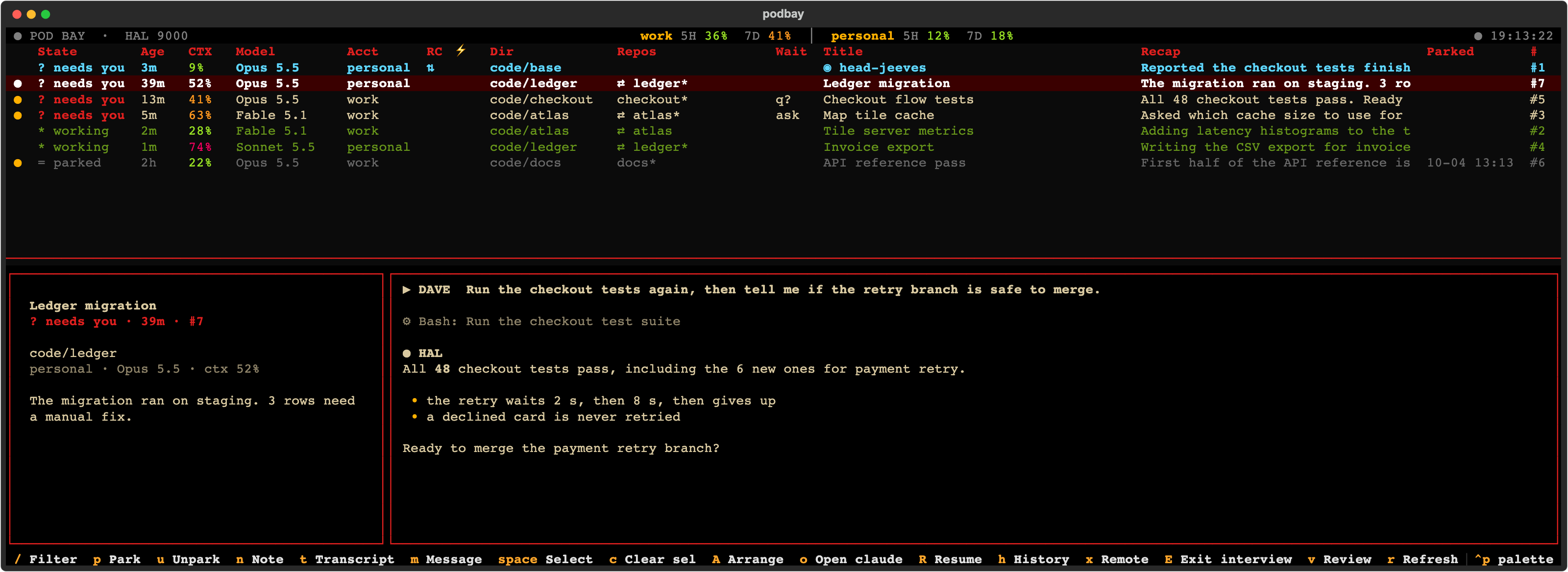
The podbay console: a table of seven Claude Code sessions with their state, age, context use, model, account, directory and title, the account quotas in the header, and the selected session's conversation below.
The console. Sessions that need you sort to the top. The lower half shows the selected session's last turns. The data here is made up.

The console

Every session, one screen

podbay reads the files Claude Code already keeps: the session registry, the end of each transcript and the status line. It finds the iTerm2 tab of each session. It never writes to Claude Code's files.

?Who needs you

A session that finished, asked a question or opened a permission dialog sorts to the top. A dot marks an answer you have not read.

*What runs

Working, stalled for ten minutes, or waiting on a background command. The state comes from the transcript, not from guesses.

%What is left

Context use per session, and the five-hour and weekly quota per account, with a projection to the reset.

↵Jump or send

Enter brings up the session's tab. m types a message into it without leaving podbay.

=Park it

Snooze a session until tomorrow 9 or +2h. It waits at the bottom until it is due.

⇄Every account

Each ~/.claude-* config dir is an account. Open and resume start Claude as the right one.

Head Jeeves

The operator you talk to from your phone

Head Jeeves is a Claude Code session that podbay keeps running. Turn on Remote Control for its account and it is the session the Claude app shows on your phone.

  • When a session finishes, asks a question or stalls, podbay tells Head Jeeves, and Head Jeeves tells you in one line.
  • Ask what is going on. Tell it to start a session in a repo with a task, or to pass a message to a session. It does that and reports back.
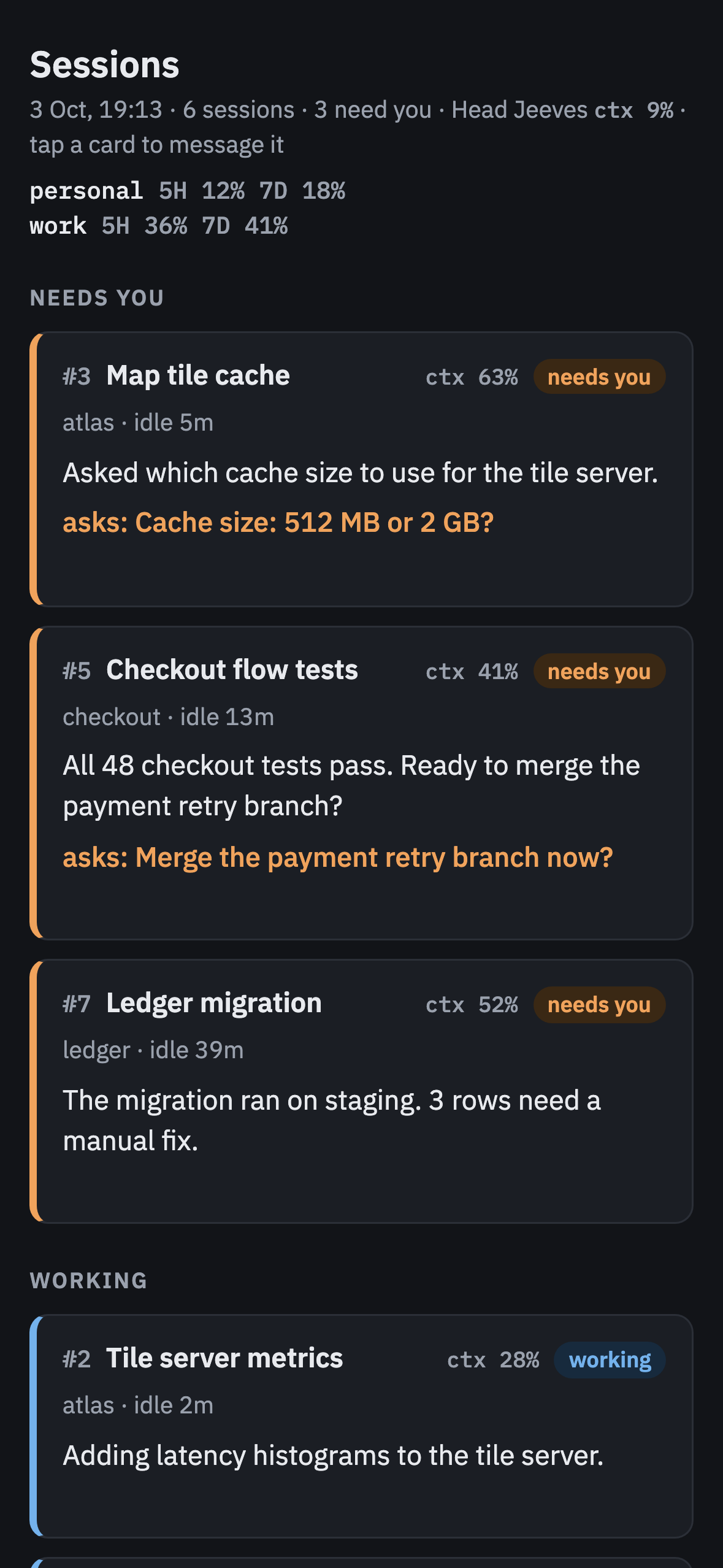
  • The session board is a page of cards that Head Jeeves publishes for you. Tap a card, type, and the message goes to that session.
  • When your prompts in a session turn heated, it reads the session and tells you what the friction is. Before you replace an agent, it writes the exit interview and a handover prompt.
The session board on a phone: cards grouped under Needs you and Working, each with the terminal number, title, repo, context use and the session's last text.
The session board, as it looks on a phone.

Install

Clone, make, run

You need macOS, iTerm2, uv and jq. On another terminal the table works, but jump and send do not.

git clone https://github.com/vesahyp/podbay.git
cd podbay
make install   # podbay on PATH, status line set

podbay         # the console
podbay config head-jeeves on

The status line is where Claude Code reports context and quota, so make install points every account's status line at podbay's script. If you keep your own, copy one block into it instead. The README has the details and every key.

podbay writes only under ~/.local/state/podbay/, and types into an iTerm2 tab only when you ask it to. MIT licensed.